Instrumentation
Four sensors working in concert to image the solar wind–atmosphere interaction at Mars.
ASPERA-3 is designed to study the solar wind–atmosphere interaction in near-Mars space through ENA (energetic neutral atom) imaging and in-situ plasma measurements.
The device is comprised of four sensors, each targeting a distinct aspect of the plasma environment. Together they provide a complete picture of how the solar wind strips Mars of its atmosphere — and its water.
View Photo Gallery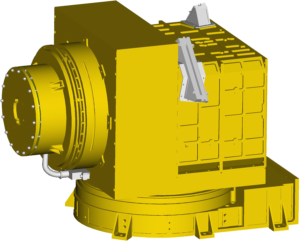
The ASPERA-3 instrument — four sensors on a single platform.
Neutral Particle Imager
The NPI sensor surveys the ENA fluxes with high angular resolution, mapping the global distribution of neutral particles escaping from the Martian environment. Working in tandem with the NPD sensor, which performs the velocity and mass measurements, NPI provides the spatial context for understanding how the solar wind interacts with the upper atmosphere.
Neutral Particle Detector
The NPD sensor extends the ENA images into two new dimensions: mass and energy. The energy spectra it produces supply direct information about the temperature and plasma bulk velocity in the interaction region and the magnetosphere.
By remotely measuring the energy of the accelerated planetary ions and the global configuration of the escaping plasma, the NPD and NPI sensors together allow a determination of the total ion outflow — the crucial parameter for understanding atmospheric erosion under solar wind action.
Electron Spectrometer
The Electron Spectrometer is a variation of the spherical tophat electrostatic analyzer (Sablik et al. 1990). The key modification is the flattening of the first 17° of the inner spherical electrode and a corresponding flattening of the spherical cap to plate — an optimization that improves energy resolution by ~3.5× for a fixed set of plate radii without significant loss of geometric factor.
Extensive effort has also been taken to ensure solar rejection of >10−13, accomplished through a light trap in the outer plate and a new form of copper black on all surfaces exposed to solar UV.
The Electron Spectrometer is funded by NASA as a Discovery Program Mission of Opportunity.
Electron Spectrometer — Specifications
| Mass | 304 gm |
|---|---|
| Power | 584 mW (including high voltage supplies and front-end electronics) |
| Dimension | 112 × 41 mm |
| Raw TM Rate | 8,192 bps |
| Energy Range | 1 eV to 20 keV (128 steps) |
| Energy Level | View energy level table |
| Energy Resolution ΔE/E | 8% |
| Acceptance Angle | 360° × ±2° |
| Geometric Factor (22.5°) | 5.77 × 10⁻⁴ cm² sr |
| Geometric Factor × ΔE/E (22.5°) | 4.75 × 10⁻⁵ cm² sr eV/eV |
Ion Mass Analyzer
The IMA is a mass-resolving spectrograph that provides measurements of the main ion components — H, H2, He, and O. The mass detection technique utilized by IMA is ideal for ions of all masses, including sub-micron sized "dusty" plasma components.
The Ion Mass Analyzer anode is funded by NASA as a Discovery Program Mission of Opportunity.
See the instrument up close
Browse photos of the ASPERA-3 hardware, assembly, and integration with Mars Express.